
The hawks tell me it’s spring. This time of year I take out the spotting scope and set it up on a tripod in the living room, looking out the tall, south-facing windows. My backyard is on a finger canyon – which is to say one of a network of small, often interconnecting canyons, none of which would vaguely qualify as “Grand”. These are a staple of southern California topography, allowing an urban-wildland interface that often threads neighborhoods. “My” finger canyon separates my street from the next one to the south and harbors predators like raptors and coyotes, as well as many of the creatures that try not to be eaten by them. Some hundreds of yards across the canyon is a giant eucalyptus tree. High in a notch of that tree is a red-tailed hawk nest.
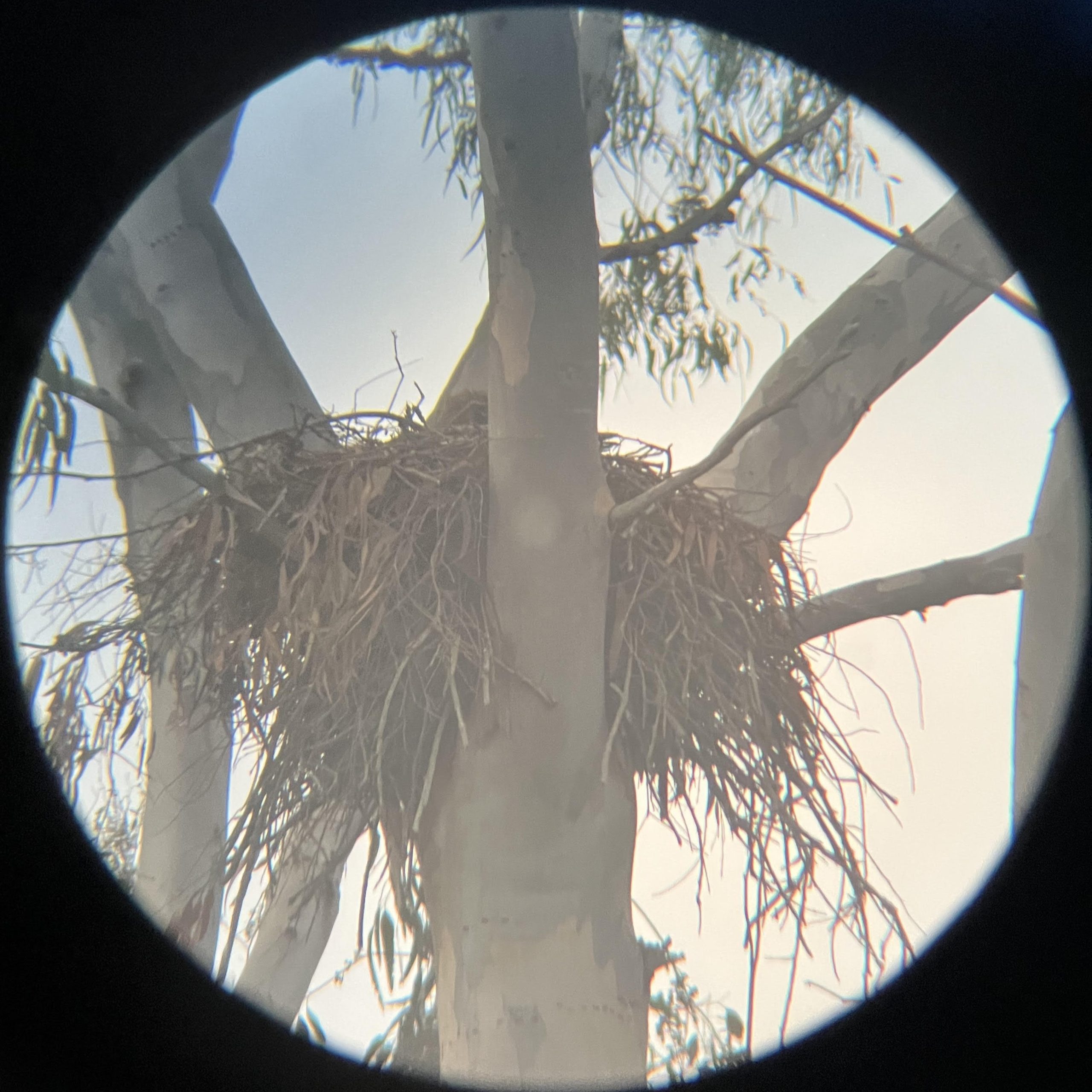
For most early springs during the quarter of a century I’ve lived here, a mating pair begins sprucing the nest in February and then, around this time, lays a clutch of eggs. I’ll set and focus the spotting scope so that the hawk’s nest nearly fills the ocular lense. Whenever the mood strikes us during the day, we’ll check in on how the next generation is progressing. It is a rite of spring. Maybe more than just a rite; it is also an important line of demarcation that the climate often refuses to clarify.
I was born in upstate New York and though my family moved to California when I was nine years old, I returned to upstate New York for college. Even though I’ve been in Southern California for part of my childhood and the vast majority of my adult life, I’ve never really acclimated to the fact that there is really only one season here. “Summer” is that one season. It lasts from roughly early March to early December. Summer means mostly sunny, relentlessly warm, and seldom rainy. The other season is “notquitesummer”, also known as “sometimescloudsorrain” or “maybeyoucanjustifyacoat”. It appears, sporadically, between mid-December to late February.
I recognize that what I describe is generally regarded as a virtue – one that drives an ever-expanding population and ever-increasing home values. I own that I’m oddly unappreciative. And yet here I am, fitfully resident, resistingly rooted, consistently contrarian.
I love the beach, but only when it’s cloudy and preferably windy, too, with a little gusted froth to the wave crests, when the sand cools rather than heats my bare soles. I don’t consider goofy, giraffe-necked palms to be real trees; a “frond” is no substitute for leaves that have the decency to hoard and spend color, relieve branches and then waiting patiently before greening them again. I’ll run on the sand, but never just sit there, beached and basking like some flippered mammal. I do not tan, but burn – swiftly and to a witchy, Salem-burnt scarlet. I favor indoor sports. My vocabulary and diction do not accommodate “dude” or “bro” or “chill”. My little bonsai garden in the back yard contains only one species native to the region. I sell rare books in a place where regard for books often seems rare.
Here is what I do appreciate. Everything here is about borders and edges, hard-won increment and hardy privations. The topography can be sudden and sharply defined. There are the canyons and mesas of course. But there are also mountains – real mountains, more than twice as tall as the tallest U.S. peak east of the Mississippi – just a weekend morning’s drive away. If you’re intrepid, you can snow shoe a mountain pass and jet ski an ocean bay in the same day, which I did once just because I could.
And there is the sheer effort and endurance of the flora and fauna. There are few surfeits available to life. Plants intemperately hasten to green after rain because it is comparatively scarce. Green itself is not a vibrant ubiquity here, but a precious subtlety; one becomes attentive to the smaller differences between growing green and desiccating dun. As for unrooted things, almost everything that thrives – whether furry or scaled or feathered – obeys a muted sartorial color wheel of grays and browns and khakis. When nature does produce a vibrant hue it is stunning, a transfixing extravagance. Instead of forests, we have the troughs of arroyos, north-facing slopes, and other low points and lees where the moisture drawn from the sea and bestowed by cooler evening air can collect just a little more and a little longer, creating comparatively lush edens in topographical creases.
And there is, of course, the coastline. The constantly shifting, sedimentary southern California shore, with its ever-eroding cliffs and beaches. The tides push and pull at life from two different worlds, adjacent but apart. The soft roar and rock-rolling susurrus of the ocean constantly wooing and wearing. The sheer abundance of people and money and dwellings and enterprise in a place with only enough naturally occurring water to support maybe a tenth of the population that insists on being here – and that pays a hefty, average-salary-exceeding premium for everything from gas to groceries for the privilege.
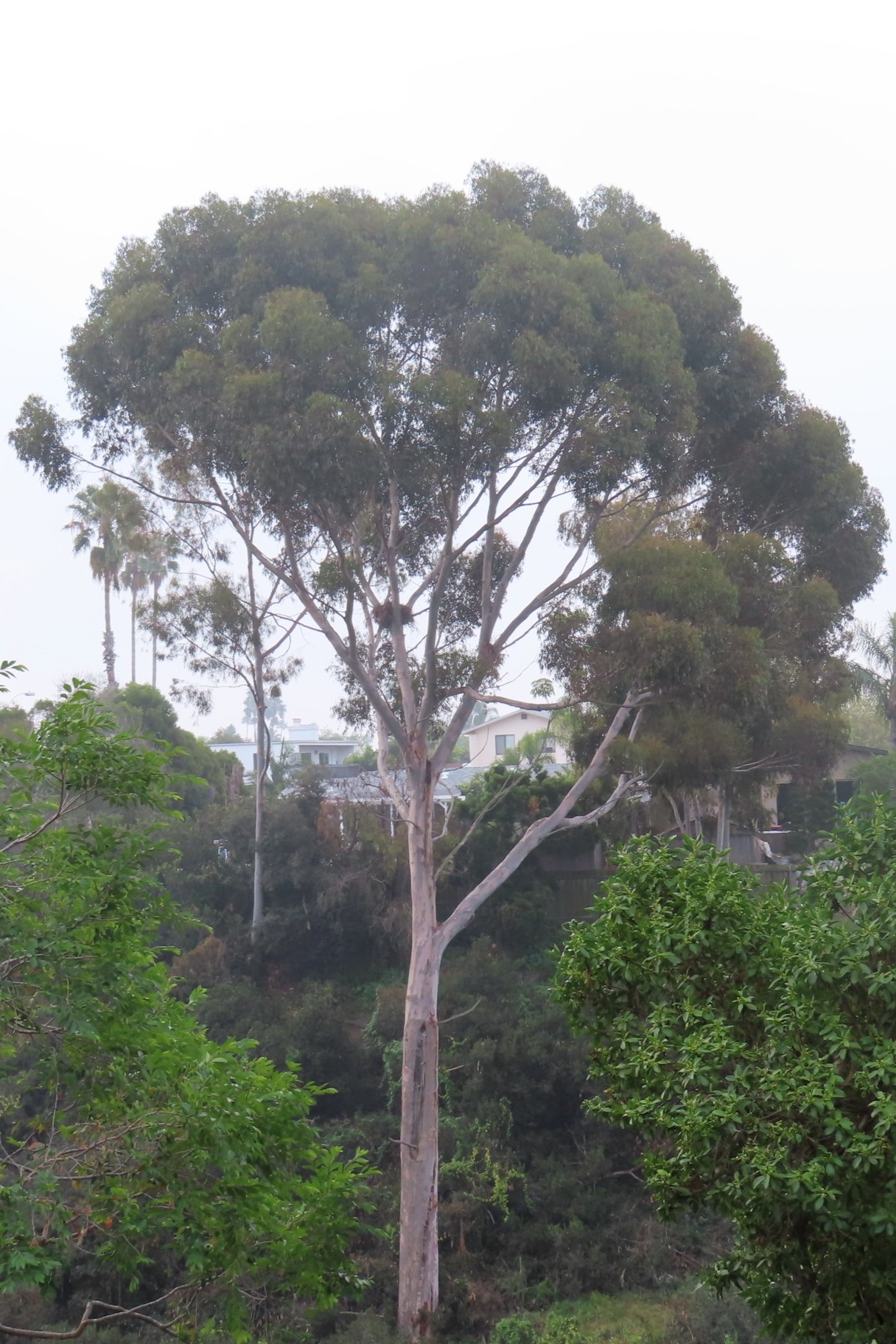
The hawks are telling me it is spring. The mighty eucalyptus in which their nest resides helps track the accumulation of years. (The eucalyptus is no more native to this place than me, its progenitors brought here from even further away than me, and for even sillier reasons – a story for another day.) Roughly a third of the trunk circumference of this particular eucalyptus peeled away with the loss of a massive limb in a storm two decades ago. I did not expect the tree – over a hundred feet tall and precariously rooted halfway up the steep opposing slope of the canyon – to survive. But over the years, the bark has stubbornly, slowly reduced the loss from a gapingly wide, notionally mortal wound to just a terrible, ever-narrowing scar. It will not close in my lifetime. It will not close in the life of the tree. But each year the tree decides to stay. Maybe for the hawks. I keep watching. Sometimes I think I understand.
2 thoughts on “Spring Hawks”