
Today – late but enthusiastic – I join the many who have written about Andrew Roberts’s new biography of Winston Churchill,Walking with Destiny.
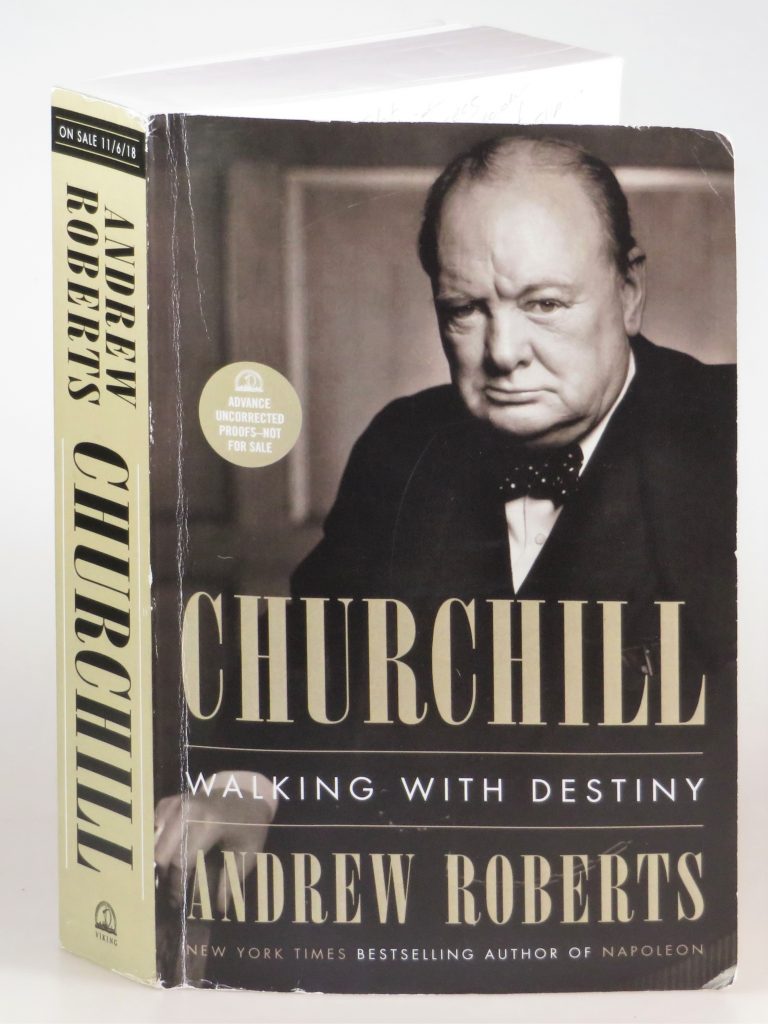
I have now read all 982 pages with care and attention, most of them twice, many more than twice. My takeaway is that Andrew Roberts has made an impressive fight.
Yes, a fight. Because wrestling a figure like Winston Churchill into biographic encapsulation is a battle. One made perhaps harder by the fact that so many have stepped into this proverbial ring before.
Which brings me to another metaphor – the elephant in the room, the venerable heavyweight champion of Churchill biography, Sir Martin Gilbert (1936-2015). Over decades, Gilbert wrote what is not only the longest, but also arguably the most thoroughly researched, exhaustively documented, most ambitiously comprehensive biography in human history. Gilbert substantially adhered to Randolph Churchill’s guiding maxim (who had borrowed it from Lockhart): “He shall be… his own biographer.” This made – in both Gilbert’s eight-volume opus and the later, one-volume condensation – a laudably informative read, but perhaps one not always compelling as a narrative.
There is no want of scholarship underpinning Andrew Roberts’s own effort. Walking with Destiny delivers a steady current of salient and evocative facts. Moreover, Roberts is conspicuously even-handed. Indeed, sometimes Roberts is almost painfully fair in framing Churchill’s errors and deficiencies – of discernment, of impulse, and of character.
But these very compliments of Roberts’s new work might beg the question – why? Why this fresh biographic work about a figure so exhaustively chronicled?
One can attempt to answer the question from a perspective of scholarship. To be sure, the hitherto unmined diaries of both the Soviet Ambassador, Ivan Maisky, and King George VI are a noteworthy addition to the historical record. They provide dimension and, in at least one case, alter some conventional perspective. Nonetheless, this new material alone would not seem to justify a wholly new thousand pages about Churchill.
So again, why?
My own answer begins simply – because once I started reading this book, despite its mammoth size and my significant familiarity with the subject, I found it quite impossible to set aside. Walking with Destiny showcases Roberts’s rare combination of manifest erudition and engaging narrative skill that only a precious few historians seem to reconcile and command. Moreover, Roberts does not just compose history, but, like his subject, has a deep sense of it. Of the unfolding and enfolding context, nuance, and import. Of the constituent elements – events, decisions, time, and place. These he weaves without warping and shades without obtrusively coloring.
In short, Roberts tells Churchill’s story compellingly, fully, and evocatively in a way at once engagingly readable, substantively filling, and intellectually provoking. That more than justifies the addition of a new biography to the canon.
To be substantive in my praise, I owe some specifics.
Speaking to Roberts’s scholarly pith, I was struck by the manner in which he repeatedly used a statistic to convey far more than bare fact. On the disappointments and unrequited supplications of Churchill’s childhood: “…in the seven years from 1885 to 1892, Churchill wrote to his parents seventy-six times; they to him six times.”
To understand the urgent compulsion of his early quest for glory, we are told how, seeking an opportunity for combat, Churchill “…took a train over 2,000 miles in five days of sweltering heat from Bangalore to Nowsherea…”
The dizzying arc of Churchill’s early ambition and burgeoning influence is illustrated thus: “In 1903 he made twenty-nine speeches (travelling over 2,200 miles), in 1904 thirty-eight (5,500 miles), in 1905 forty-four (over 3,700 miles), in 1906 fifty-nine (3,800 miles) and in 1907 (despite his East African trip) forty-two. These speeches of often more than 5,000 words each…. He kept up this extraordinarily high level… even after the peak year of 1908, with sixty-nine speeches in 1909, seventy-seven in 1910 and sixty-five in 1911, traveling a total of 10,000 miles to deliver them.”
Regarding the impactful and enduring presence of the Other Club in Churchill’s life: “Churchill was to attend more than 300 dinners of the Other Club, by far the largest number of meals he ever had in one place other than with his own family.”
The highly effective use of fact to limn Churchill’s character and core is not limited to statistics.
Roberts tells us that “Churchill habitually drove fast, routinely jumped traffic lights and occasionally went up on to the pavement when faced with traffic congestion.” It is no great effort to make the metaphorical extension to many aspects of Churchill’s life.
But Roberts’s effort is more than clever application of fact and extrapolated metaphor. Churchill was masterfully able to locate himself, his people, his place, and his time in the tributaries and currents of history. Roberts is similarly able to tease and trace the many convergences threading Churchill’s life. Sometimes this is fairly straightforward; Roberts highlights that it was Churchill’s loss in his first bid for Parliament that left him free to go to South Africa, where he won the fame that catapulted him to prominence. Sometimes the connections are more subtle, but no less vital; Roberts draws the connection between Churchill’s early, formative experience with fanaticism in the Victorian colonial conflicts of sub-Saharan Africa to Churchill’s instinctive, recoiling identification of similar fanaticism in Nazi Germany decades later. Likewise, rather than simply cataloguing Churchill’s more obstinate decisions – both good and bad – Roberts illuminates these decisions as a path both consonant with and illuminating Churchill’s guiding principles, beliefs, and impulses.
Churchill’s death came half a decade before my birth, so I am without any living memory of him. I’m interested in the man because he is interesting. And perfection is not interesting. I find Churchill engaging for his humanity and loathe hagiography which, to my reckoning, diminishes both the reality and relevance of Churchill’s remarkable life and character.
Among Roberts’s gifts to readers is not only unsqueamish disclosure of Churchill’s errors of judgement, but also acknowledgement of where Churchill’s core notions deviate from modern sensibilities. But this is done without a partisan agenda. Roberts neither selectively edits statements and events to demonize Churchill, nor apologizes for when Churchill was boorish or wrong. Rather, Roberts deftly contextualizes, revealing flaws and deficiencies in a manner that better suits frank understanding than retroactive judgement.
Roberts’s discussion of Churchill’s views on women’s suffrage is a case in point. The portrayal of Churchill’s views and political postures was honest enough to make me wince. But, most illuminating, there is a particular incident related when Churchill, on the cusp of adopting a more progressive position, instead literally orates himself into a reactionary retreat. It is painful. It is certainly no “finest hour”. But it is fascinating, informative, and of a piece that Churchill’s oratory could sway not just the mind and will of others, but his own as well.
In his Conclusion, Roberts spends nearly an entire page cataloging “many times when Churchill’s judgement could legitimately be called into question”. The list is excruciating to read. And it is justly set upon the scales. Yet such is the nature of Roberts’s balanced presentations that this inventory of fault and failure can be acknowledged, absorbed, and carefully weighed.
As can Roberts’s own book. To be sure, Walking with Destiny is not a flawless effort. It was a fight, and some of the knuckled thrusts and bumps are hard to obscure. To the point is Roberts’s intriguing decision to remain fairly even-handed in the massive, 951-page sweep of the narrative while saving the weighty Conclusion (pages 965-982) for more partial contextualization. “Conclusion” understates; this is a lengthy, substantive, referential essay that, frankly, feels of sufficient weight to stand and be read on its own, rather than simply mortar and tassel the book.
But even this – though far from seamless – worked very well for me as a reader. In retrospect, it afforded a salutary digestive exercise – opportunity for a lengthy, provoking, warts-and-all regard for the sweep of Churchill’s life before having it more conspicuously hued and appraised. Roberts’s Conclusion proved to be the literary equivalent of a strong tonic, brisk walk, and settling reflection after a taxingly large, rich, and volubly companioned repast.
Churchill once wrote that “Writing a book is an adventure. To begin with it is a toy, then an amusement. Then it becomes a mistress, and then it becomes a master, and then it becomes a tyrant and, in the last stage, just as you are about to be reconciled to your servitude, you kill the monster and fling him to the public.” Roberts might identify. There is that sense here that Roberts’s undertaking was no gentle affair, but more of a Churchillian struggle in its intellectual and narrative demands and exertions. This seems fitting to the life Andrew Roberts has so ably framed and chronicled.
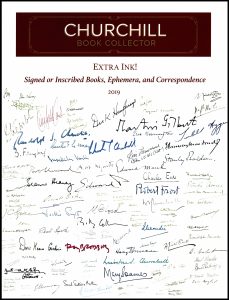
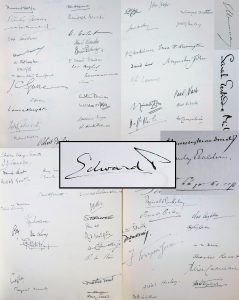
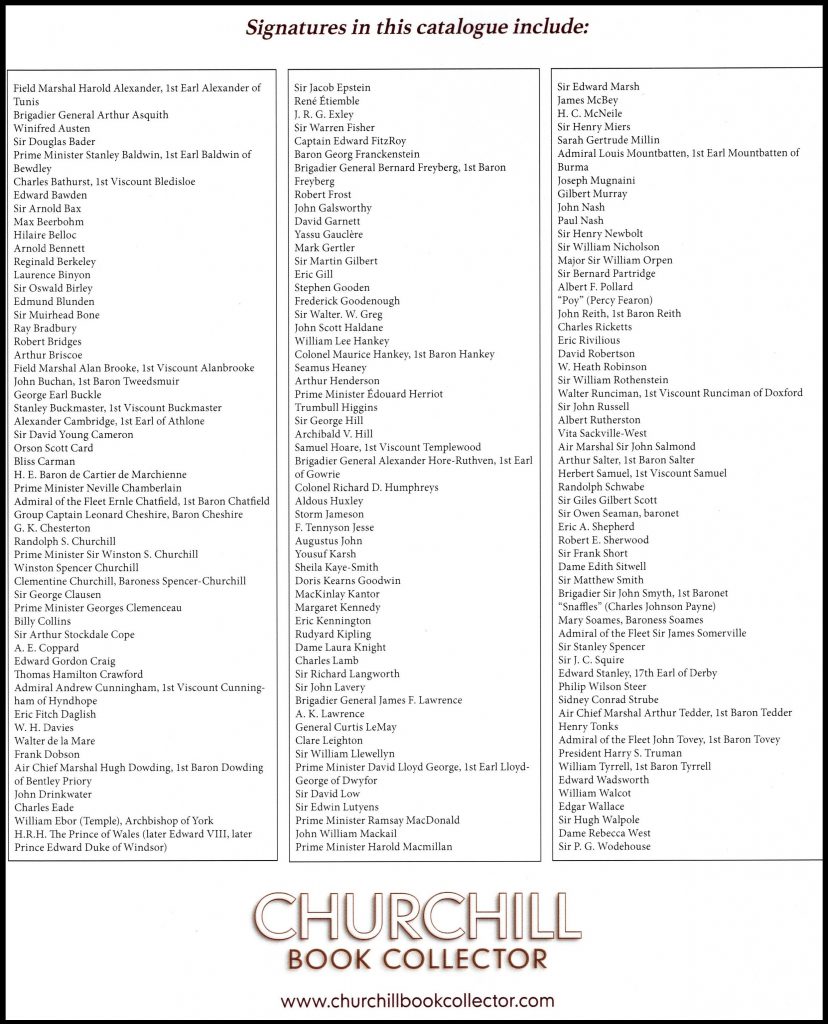
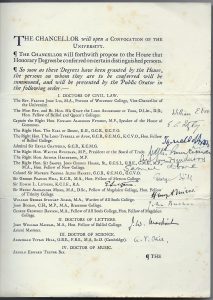
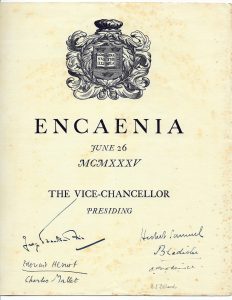
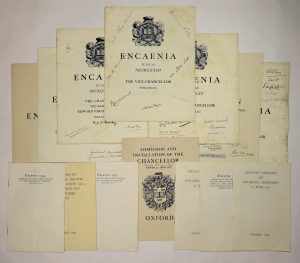 Among the 40 items in our forthcoming catalogue is a collection of Oxford Encaenia program(me)s rendered unique by the signatures of 53 distinguished honorees. The signatures include Prime Ministers Winston Churchill, Neville Chamberlain, and Harold Macmillan, President Harry S. Truman, three Nobel Prize winners, House Speakers and Party Leaders, scholars and war heroes, poets and architects, and such quintessentially British figures as the first Director-General of the BBC, the editor of Punch, and the designer of the London’s iconic red phone booth.
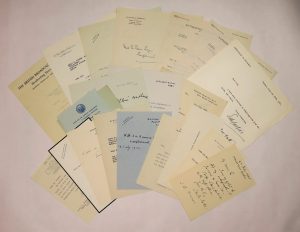 These signatures were collected by Lewis Frewer, an Oxford autograph collector whose meticulously catalogued collection of personally acquired signatures of statesmen, sportsmen, and figures of the stage and screen totaled over 2,000 items. This portion of his collection includes 12 signed programs and 35 additional items chiefly comprising letters attesting to the provenance for many of the signatures.
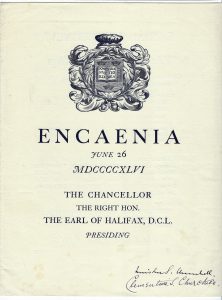 Of course, the figure central to Allied victory, Winston S. Churchill, is also present. However, the honor of Doctor of Civil Law was not placed on the wartime Prime Minister but on his wife, Clementine, whose signature nevertheless appears below her lauded husband and who is referred to in the program as only “Mrs. Churchill”.
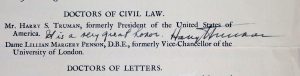 Immediately after the elections Truman’s name was resubmitted for 1955 and approved. However, Truman would not be able to attend the ceremony until the following year. This again made more trouble for the Foreign Office, as 1956 was an election year, creating a conflict between the embarrassment of delaying the former President’s honor and the consequences of perceived favoritism in American elections. The solution was to include Truman in the 1956 ceremony while making it explicit that he was a holdover from the previous year. Truman’s inscription, that “it is a very great honor”, might be regarded as gracefully acknowledging the political maneuvering required to include him in the Encaenia.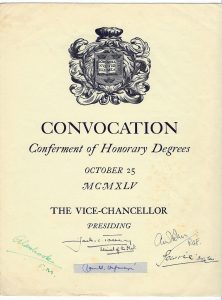
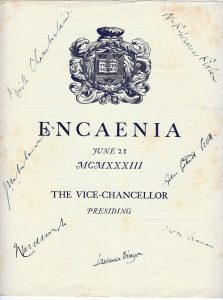 Encaenia, June 21, 1933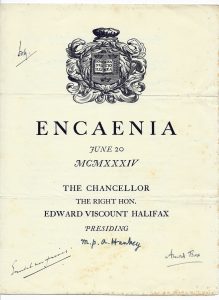
 The First World War is often eclipsed by the conflagrations of the latter part of the twentieth century, notably the Second World War and Cold War. But it was the First World War that truly stunned civilization, ushering an age of inconceivable carnage and industrialized brutality. When war came in August 1914, prevailing sentiment held that the conflict would be decisive and short. “You will be home before the leaves have fallen from the trees,” Kaiser Wilhelm assured his troops leaving for the front. More than four extraordinarily bloody years followed, lasting until the eleventh hour of the eleventh day of the eleventh month of 1918. In his own history of WWI, Winston Churchill wrote: “Overwhelming populations, unlimited resources, measureless sacrifice… could not prevail for fifty months…”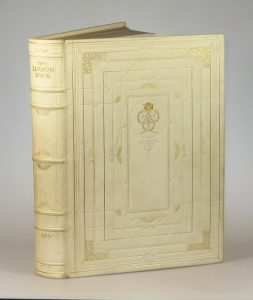
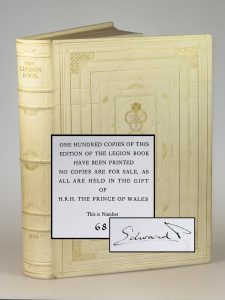
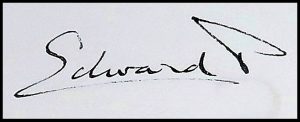
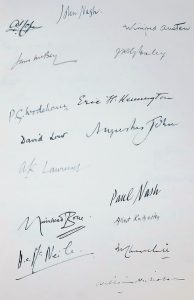
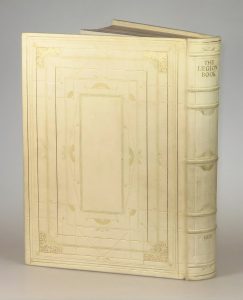 The Legion Book was commissioned by the Legion’s patron, H.R.H. The Prince of Wales (later Edward VIII and, after abdication, the Duke of Windsor). Sale proceeds were dedicated to the Legion. The dozens of contributing artists and writers were among the most talented British subjects in their fields, including Winston Churchill, Rudyard Kipling, P.G. Wodehouse, Aldous Huxley, Vita Sackville-West, G.K. Chesterton, Hilaire Belloc, Augustus John, Eric Kennington, and John Nash. The book was edited by James Humphrey Cotton Minchin (1894-1966), a WWI veteran of the Cameronians and the Royal Flying Corps. Trade editions ran to multiple printings. There was also a 600 copy limited edition. 500 of these were signed by the editor and bound similarly to trade editions. But “the first 100 were reserved for H.R.H. the Prince of Wales, sponsor of the volume, in his gift.”
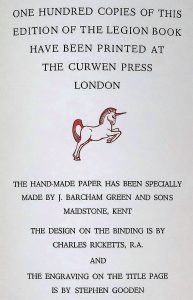 These hundred were simply magnificent – printed in red and black by The Curwen Press on larger, hand-made paper, profusely illustrated, extravagantly bound in elaborate blind and gilt-tooled white pigskin. Massive volumes, they measure 13 x 10 x 2 inches and weigh 6.6 pounds. Each copy was hand-numbered.
 Winifred Austen
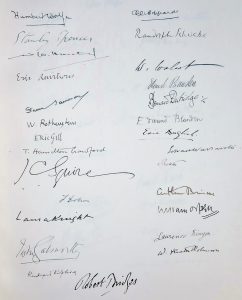 Laurence Binyon
 Sir Arthur Cope
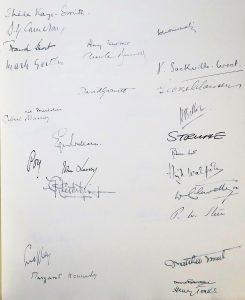 David Garnett
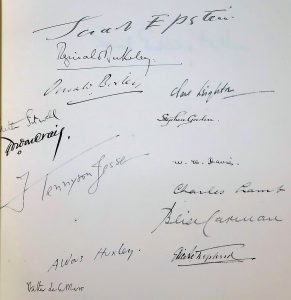 Dame Laura Knight
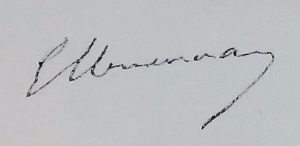 Gilbert Murray
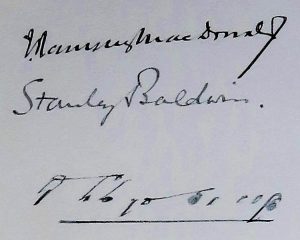 Charles Ricketts
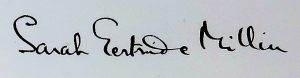 Edith Sitwell
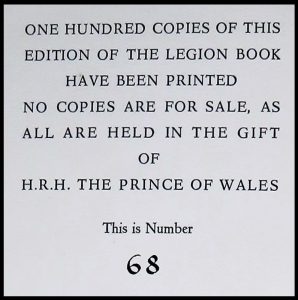 We will soon be pleased to offer an unusually fine example, copy “68”, hand-numbered thus on the limitation page. The binding and contents are nearly flawless.
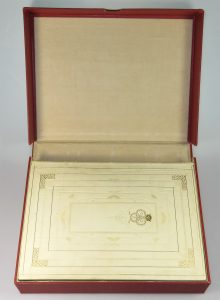 Superlative condition owes to the presence of the original felt-lined cloth clamshell case, with a discreet, inked “No.68” on the upper front cover.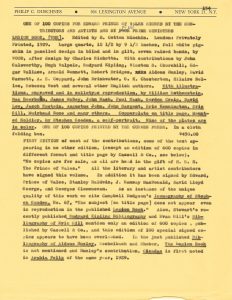
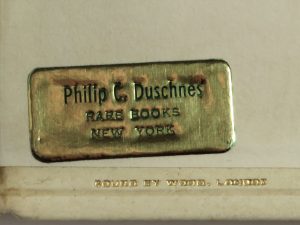 Laid in the case is an original description of this book by noted New York bookseller Philip C. Duschnes, who died in 1970. His tiny gilt sticker is affixed to the lower rear pastedown.
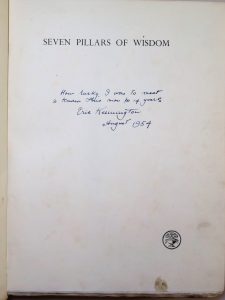
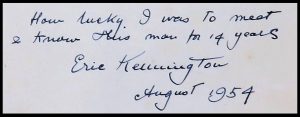 Today, a first trade edition of Seven Pillars of Wisdomrendered special by a poignant inscription by Eric Kennington, the man who created thirty-one of the illustrations within its pages. Inked in blue in four lines on the half title, Kennington wrote: “How lucky I was to meet | & know this man for 14 years | Eric Kennington | August 1954”.
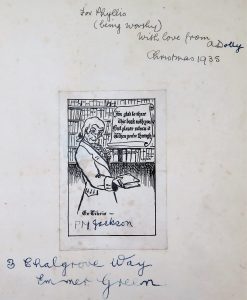 A gift inscription “For Phyllis” dated “Christmas 1935” is inked on the front free endpaper above the illustrated book plate of “PM Jackson”.
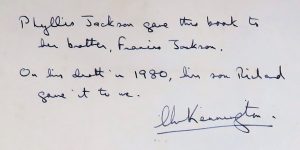 A five-line inked notation on the front free endpaper verso that appears to be signed by Christopher Kennington (Eric Kennington’s son) reads: “Phyllis Jackson gave this book to | her brother, Francis Jackson. | On his death in 1980, his son Richard | gave it to me.”
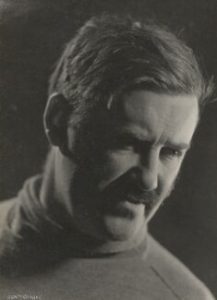 Eric Henri Kennington (1888-1960) was known as a painter, print maker, and sculptor and, most notably, as “a born painter of the nameless heroes of the rank and file” whom he portrayed during both the First and Second World War.
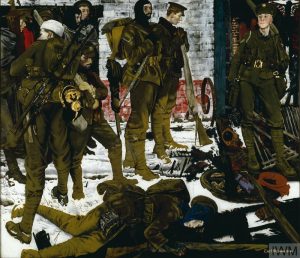 Badly wounded on the Western Front in 1915, during his convalescence he produced The Kensingtons at Laventie, a portrait of a group of infantrymen. When exhibited in the spring of 1916 its portrayal of exhausted soldiers created a sensation. Kennington finished the war employed as a war artist by the Ministry of Information. After the war, he met T. E. Lawrence at an exhibition of Kennington’s war art.
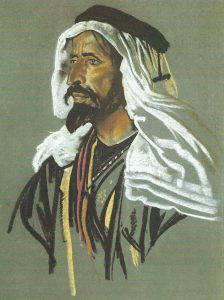 In 1921, Kennington traveled to the Middle East with Lawrence where, Lawrence approvingly wrote of his work, “instinctively he drew the men of the desert.” Kennington served as art editor for Lawrence’s legendary 1926 Subscribers’ Edition of Seven Pillars of Wisdomand produced many of the drawings therein.
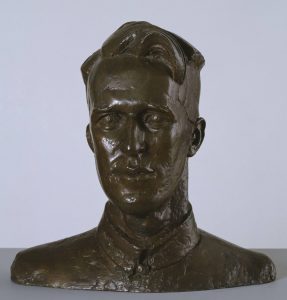 That same year he produced a bust of Lawrence – an image of which is the frontispiece of this book. On 15 February 1927, Lawrence wrote to Kennington praising the bust as “magnificent”. Lawrence said “It represents not me, but my top-moments, those few seconds in which I succeed in thinking myself right out of things.” In 1935, Kennington served as one of Lawrence’s pallbearers.
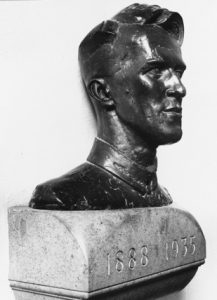 In 1936 his second, memorial bust of Lawrence was installed in the crypt of St. Paul’s Cathedral. Kennington was again an official war artist for the British government during the Second World War (Ministry of Information and Air Ministry), producing a large number of portraits of individual soldiers in addition to military scenes. Kennington died a member of the Royal Academy six years after writing the inscription in this book.
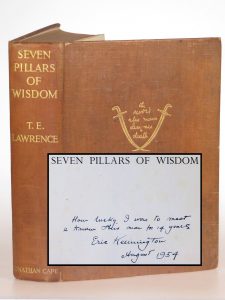 It was only in the summer of 1935, in the weeks following Lawrence’s death, that the text of the Subscribers’ Edition text was finally published for circulation to the general public in the form of a British first trade edition. This copy inscribed by Kennington is the first printing of this British first trade edition. Condition is good, showing the aesthetic flaws of age and wear, but sound. The khaki cloth binding is square and tight with wear to extremities, overall soiling and staining, and considerable scuffing to the rear cover. The contents are clean with toning to the page edges. A tiny Colchester bookseller sticker is affixed to the lower rear pastedown.
 Look for this and dozens of other signed or inscribed items in our “Extra Ink” catalogue late in 2018!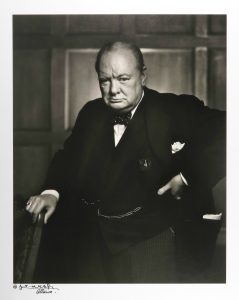
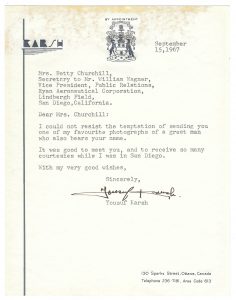 The photo itself is signed by Karsh in black in two lines on the lower left margin of the photo “© Y Karsh | Ottawa.” But in addition to Karsh’s signature, this photo comes with a presentation letter from Karsh typed on his Ottawa studio stationery and signed “Yousuf Karsh.” The letter is dated “September 15, 1967” and addressed: “Mrs. Betty Churchill, Secretary to Mr. William Wagner, Vice President, Public Relations, Ryan Aeronautical Corporation, Lindbergh Field, San Diego, California.”
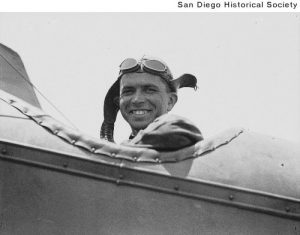 Tubal Claude Ryan (1898-1982) bought his first airplane, a Curtiss JN-4 Jenny, in San Diego in 1922, and began his aeronautical enterprises by charging for rides. By the late 1920s his aviation ventures included the nation’s first year-round regularly scheduled daily airline passenger service. In 1927, Ryan’s namesake company was tasked with building a single-engine plane that would be called The Spirit of St. Louis for a fellow named Charles Lindbergh.
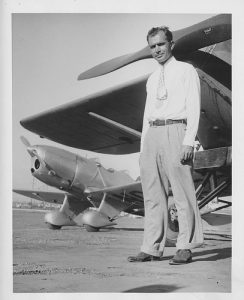 After Lindberg’s historic solo flight, in 1928 Ryan founded The Ryan Aeronautical Corporation. This company, among many accomplishments, built the preeminent trainer aircraft used though the Second World War, the first jet-plus-propeller aircraft for the Navy, and the first successful vertical takeoff and landing aircraft, as well as pioneering remotely piloted vehicles and jet drones, Doppler systems, and lunar landing radar.
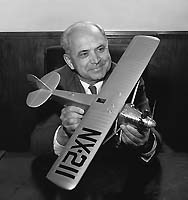 In 1969, just a few years after this photograph was signed and presented by Karsh, Ryan Aeronautical became Teledyne Ryan, a subsidiary of Teledyne, at an acquisition price of $128 million. Teledyne Ryan became, in turn, part of Northrop Grumman in 1999.
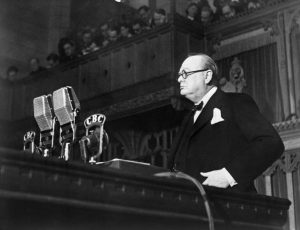 Churchill’s speech of December 26, 1941 to a joint session of the U.S. Congress was sober, resolved, and eloquently defiant, but of course also featured the sparkle of Churchillian wit, which was irrepressible even in the dark hours of the war: “I cannot help reflecting that if my father had been American and my mother British, instead of the other way around, I might have got here on my own.” His speech was also an important personal introduction to the elected leaders he needed to embrace the alliance so vital to his nation. A few days later, in his famous “Some chicken, some neck!” speech of December 30 to both houses of the Canadian Parliament, Churchill was characteristically defiant: “When I warned them that Britain would fight alone whatever they did, their generals told their Prime Minister and his divided Cabinet ‘In three weeks England will have her neck wrung like a chicken.’ Some chicken; some neck.”
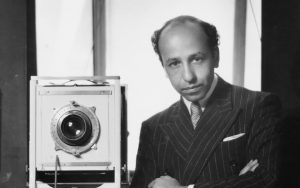 Born in Armenian Turkey, Karsh had fled on foot with his family to Syria before immigrating to Canada in 1924 as a refugee. After apprenticing with the celebrity portrait photographer John H. Garo, Karsh moved to Ottawa, where he opened a portrait studio with the intent of photographing “people of consequence.” His breakthrough came in 1936 when he photographed the meeting between U.S. President
 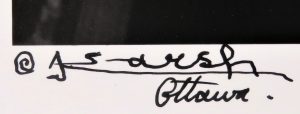 Printing date is established by the letter and the fact that Karsh stopped signing his photos with “Ottawa” in the late 1960s. The image verso bears the studio stamp of Karsh’s Ottawa studio reading “COPYRIGHT | the following copyright must be used | © Karsh, Ottawa” as well as a penciled “P of G” notation referring to the image’s inclusion in Karsh’s book Portraits of Greatness(1959).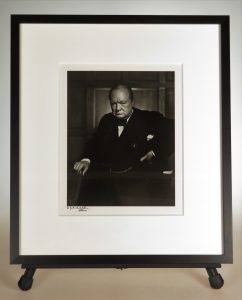
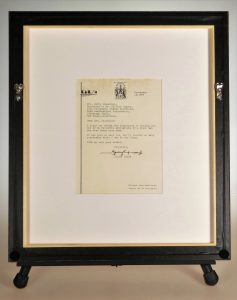 We deliberately chose not to frame in the conventional manner, with the photo matted and framed beside the letter. The photo is simply too striking an image to warrant the aesthetic distraction of the letter right beside it. Instead, we commissioned a custom, double-sided frame using museum quality, archival materials. The solid walnut frame is stained dark black with a thick 8-ply rag board mat for added depth and richness and is glazed with UV filtering acrylic. On the reverse the letter has also been matted and glazed. The framed piece measures 17.375 x 15.375 inches (44.1 x 39 cm).
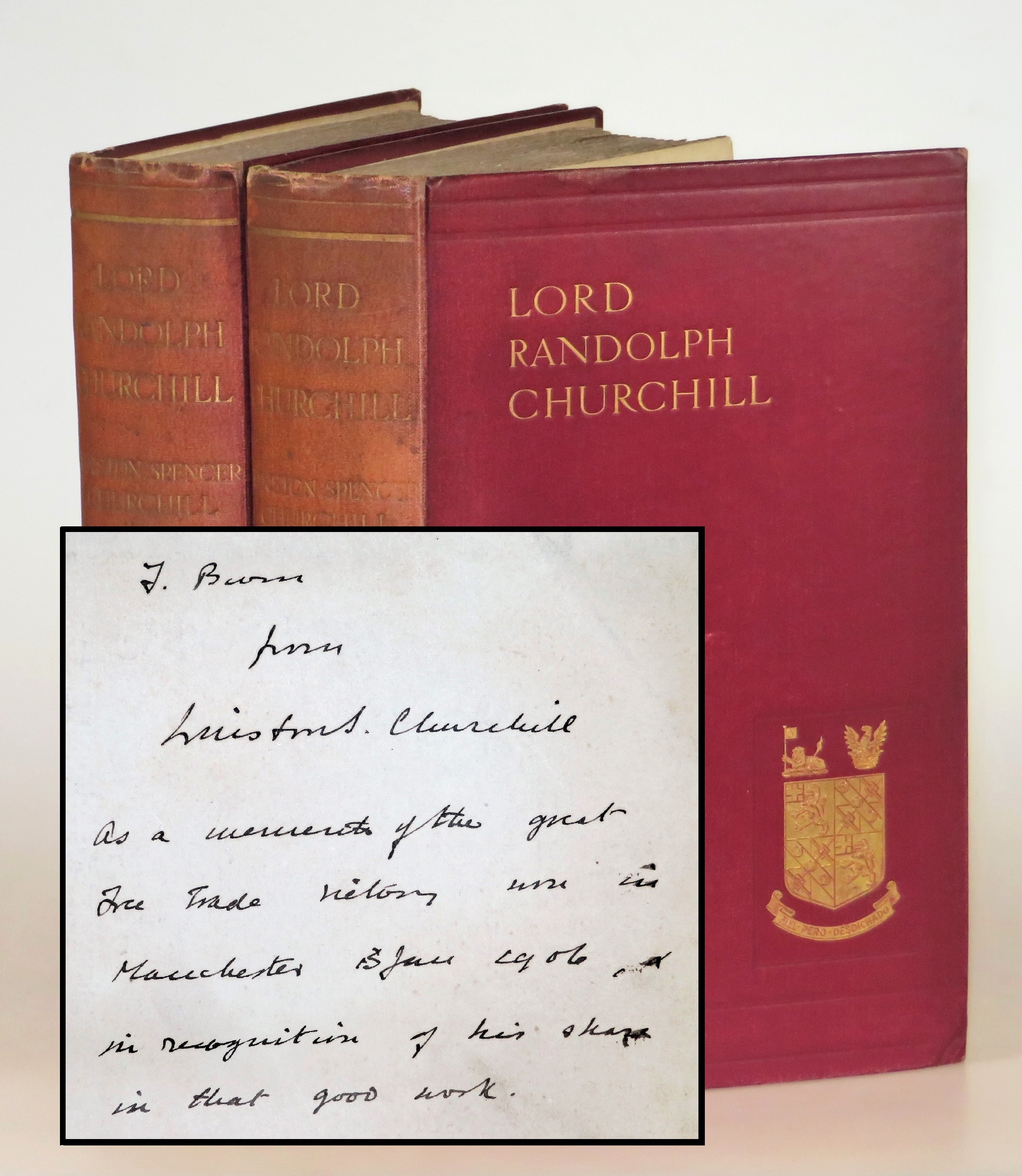
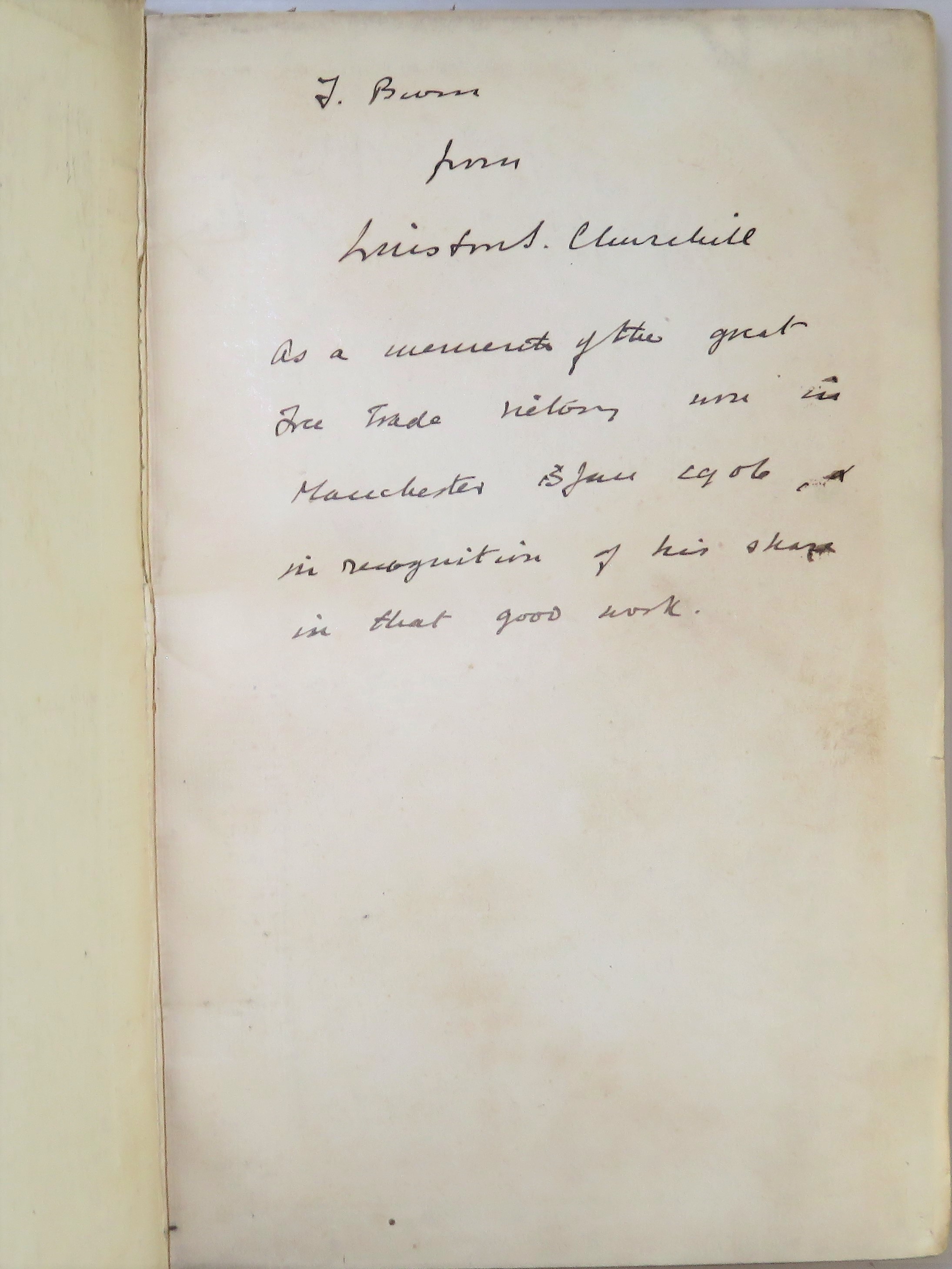
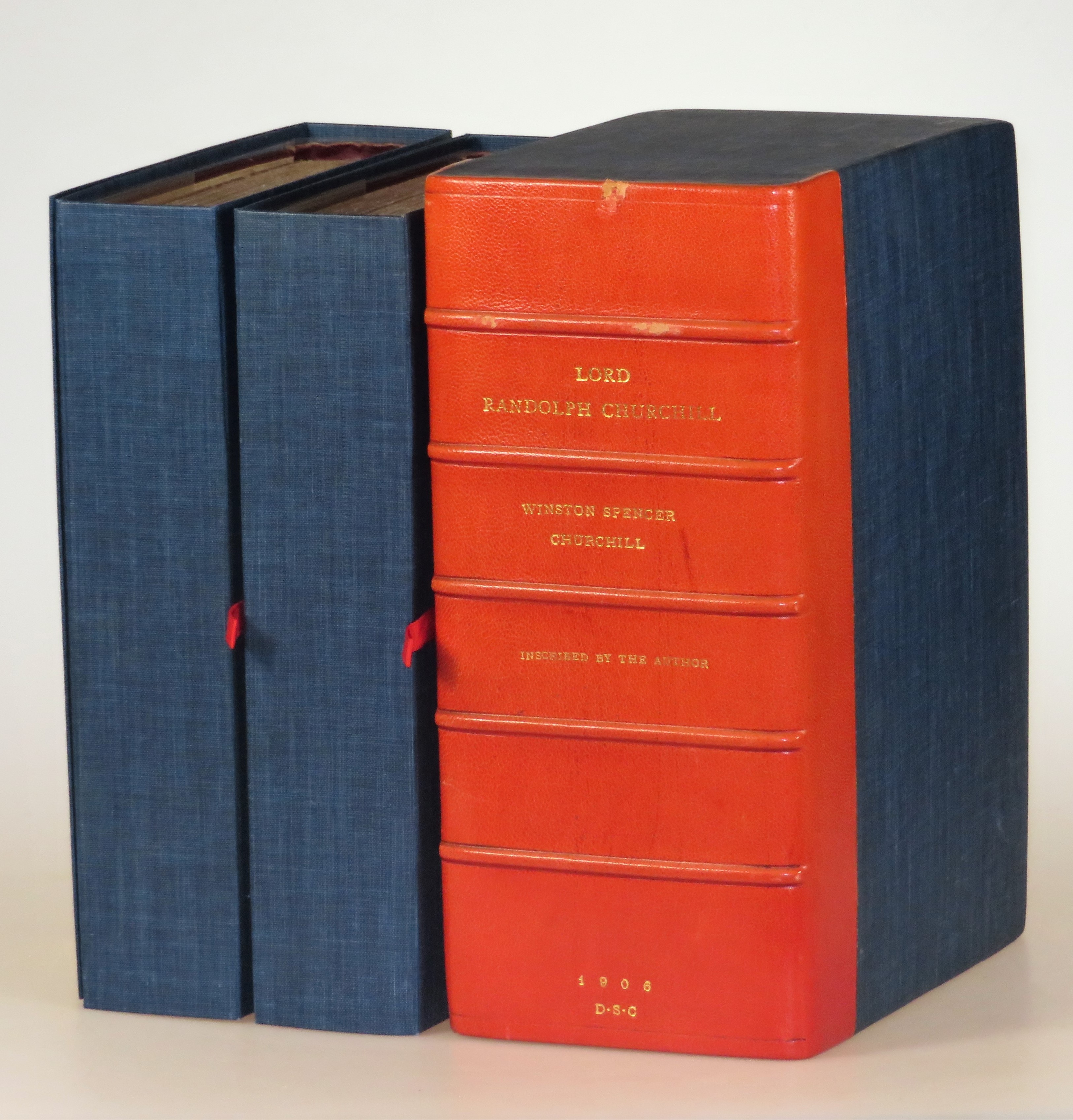
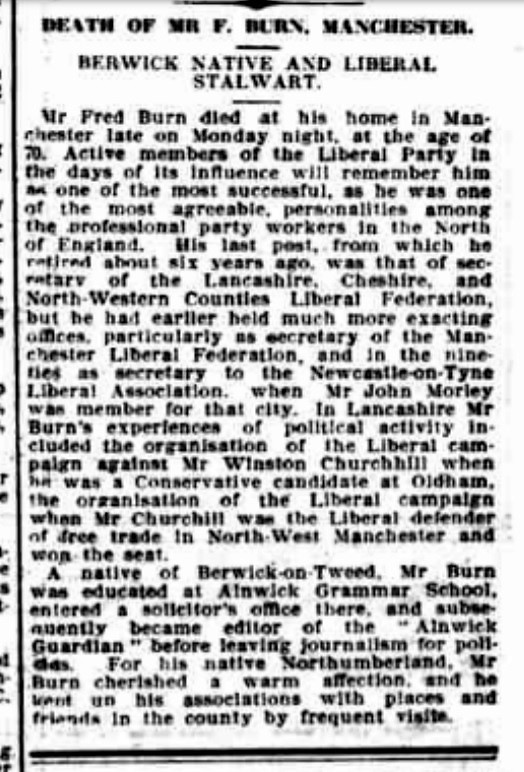
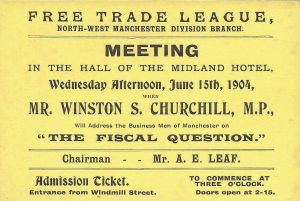
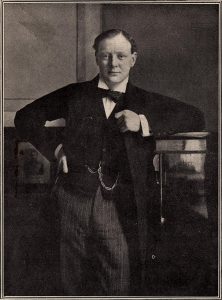 On 31 May 1904 Churchill left his father’s Conservative Party, crossing the aisle to become a Liberal, beginning a dynamic chapter in his political career that saw him champion progressive causes and branded a traitor to his class. On 2 January 1906 Churchill published his two-volume biography of his father. Immediately thereafter, he campaigned for eight days in North-West Manchester, hoping to win his first election as a Liberal.
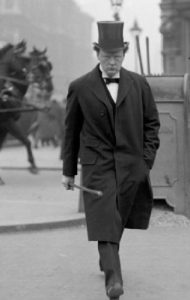 Churchill’s defection from the Conservative Party was much on the minds of the voters. His father’s history was much on his own mind. To the charge of being a political turncoat, Churchill replied: “I admit I have changed my Party. I don’t deny it. I am proud of it. When I think of all of the labours Lord Randolph Churchill gave to the fortunes of the Conservative Party and the ungrateful way he was treated by them when they obtained the power they would never have had but for him, I am delighted that circumstances have enabled me to break with them while I am still young, and still have the best energies of my life to give to the popular cause.”
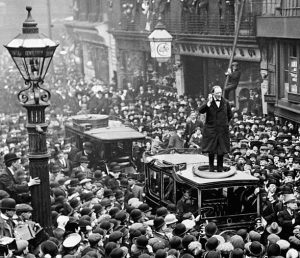 North-West Manchester would prove a brief and fraught interlude in Churchill’s six-decade Parliamentary career, his shortest relationship among the five constituencies he ultimately held. In 1908 when Churchill was appointed to the Cabinet as President of the Board of Trade, custom required that he submit to re-election. His by-election became a test of confidence in the Liberal government. Forced to defend the Government’s policies, targeted by vengeful Conservatives, and hounded on the hustings by Suffragettes, Churchill was narrowly defeated by the Conservative candidate.
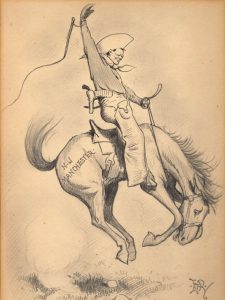 Nonetheless, the 13 January 1906 election and Churchill’s brief time as M.P. for North-West Manchester made all things possible for him. At 31 years old, “Churchill was now a Junior Minister in a Government furnished with far greater authority than it had expected.” Disraeli’s biographer wrote to congratulate Churchill “both on his book and the beginning of his official career”.
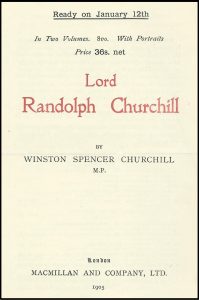 All this was as yet unseen when he won his first seat as a Liberal in North-West Manchester on 13 January 1906. Nonetheless, we can reasonably speculate that the importance of the victory was not lost upon Churchill. Churchill’s biography of his father had helped place Lord Randolph in historical context. We can also speculate that Churchill’s electoral victory as a Liberal in North-West Manchester helped Churchill put the specter of Lord Randolph’s failed political career behind him. Perhaps all of this was in Churchill’s mind – or perhaps he was simply grateful – when he paused to warmly inscribe this first edition of his newly published book to the man who helped him achieve success. Irrespective, this presentation set testifies to the remarkable convergences of a pivotal moment in the life of both ascending Winstons – the literary and the political.